The sun heats it. The shape sorts it. The ground steadies it.
One very old idea, one new material
A Roman arch is a half circle: the span fixes the height, and the whole structure shoves outward at the bottom. The gothic builders broke that link. By meeting two steep curves at a point, they could choose the height independently of the span, aim the load more steeply into the ground, and open the walls up to glass.
What they couldn't do was carry tension. Stone only pushes — so every one of those cathedrals needed flying buttresses standing outside to catch the sideways thrust. Laminated wood pushes and pulls. That single difference is what lets the Sophab Arch trade a stone buttress for a bolted connection to the wall you already have, and a footing for a screw pile.
Vertical at the foot, pointed at the top
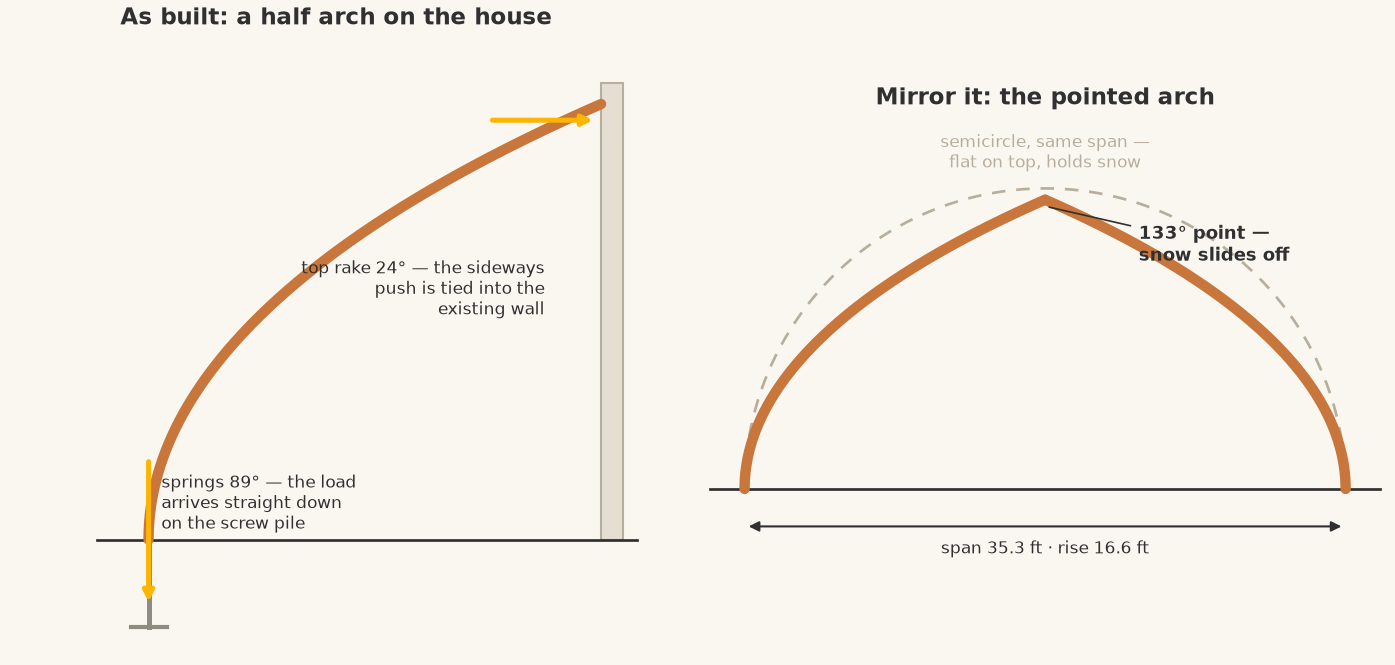
Our rib is an arc of an ellipse, drawn so that it leaves the ground dead vertical and arrives at the house raked over at about 24°. Used singly it's a lean-to on your wall; mirror it and the pointed arch appears, with a 133° point at the crown.
Drawn from the as-built profile of the first full-sized arch. Every Sophab is adapted from that set to your own building's dimensions, and reviewed and sealed by your engineer of record.
What actually goes in the ground
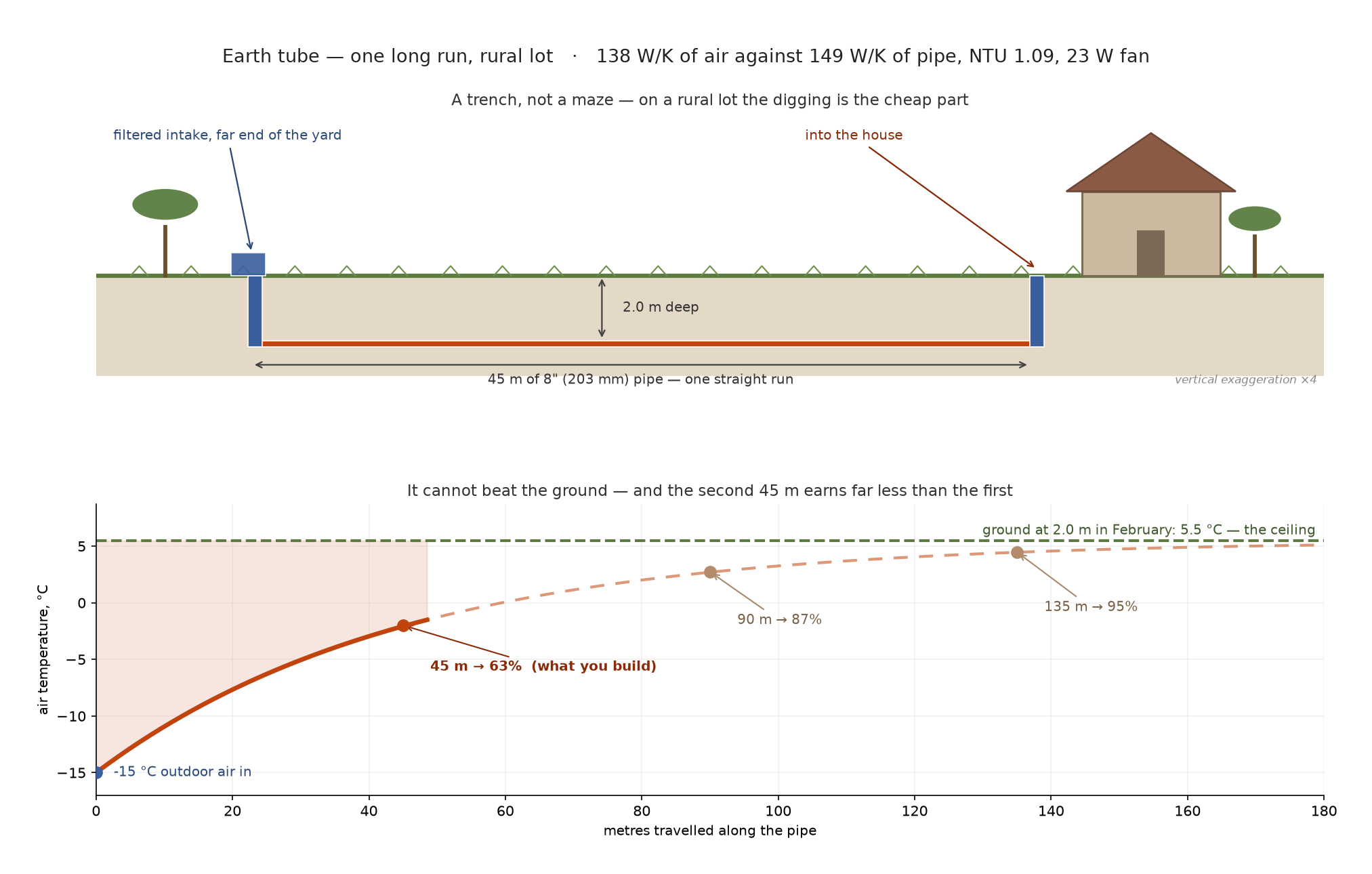
On a rural lot the digging is the cheap part, so the honest shape is the simplest one: a single straight trench across the yard, a filtered intake at the far end, and a riser into the house.
One run — not a maze. A branching manifold splits the air across every leg, and each one then crawls: surface area is free to draw and expensive to use, because a slower pipe swaps heat worse. Keeping the whole flow in one pipe gets 68% of the available lift out of 49 m, where a compact manifold needs 59 m to manage 50%. Less pipe, better result.
Depth > pipe — two more feet down beats twice the pipe. The seasonal wave is what you are digging away from: at 4 ft the ground sits near 3 °C in February, at 6 ft near 5 °C, at 8 ft near 6.5. Warmer ground raises the ceiling; more pipe only walks you further up towards a ceiling you already had.
It has a ceiling — and the graph is it. The outlet chases ground temperature and can never pass it, so the curve flattens: the first 45 m buys 63% of the lift, the next 45 buys 24 more, the next 45 buys 8. That is why “just add more pipe” quietly stops working, and why the flow rate — not the trench — sets what the device can ever do.
Fall + cleanouts — every run condenses. A buried tube in this climate collects water, so it has to fall continuously to a drained low point with a cleanout at each end. Without that, standing water grows biofilm and the fan delivers it indoors. It is a health detail, not a thermal one, and no efficiency figure covers it.
Screening geometry for planning, not a construction detail. Your own layout, depth and pipe size come from the earth-tube model, and your own engineer sizes and seals the real installation.